

In this article
What does a RAW view preserve?
RAW keeps each source’s crypto options observations identifiable. AGG combines eligible, compatible observations using a rule defined for each measure. This guide explains the difference with an illustrative open-interest example.
RAW keeps the source in scope: which contract the observation describes, the reported value and unit, and when that observation was made. It does not necessarily mean an untouched API response. A displayed RAW field can already use a documented conversion or formatting rule; the original unit and transformation still need to be traceable.
Open interest is the quantity of outstanding contracts, expressed in the source’s stated unit. For example: how much open interest is reported for compatible BTC call contracts at a particular strike and expiry? That is different from asking for the largest trade, the best quote or the implied volatility of the market.
When are observations comparable?
An underlying, strike and date are not a complete contract identity. Before comparing two observations, check the option type, exact expiry time, settlement, exercise style and any contract specifications that affect the payoff.
Then check the unit. A contract count, an amount in BTC and a USD notional are different quantities. A conversion needs the relevant contract multiplier and a stated convention. If a required specification is missing, leave the comparison unavailable rather than guessing it.
Source names and similar instrument symbols do not establish equivalence. Keep the original identifiers alongside the normalized identity so a result can be traced back to its inputs.
- Match the contract specifications, not just the symbol.
- Check the original unit, multiplier and any conversion.
- Compare observation times under a stated eligibility rule.
- Identify repeated snapshots from the same source separately from independent contributions.
What does AGG mean for each measure?
AGG brings eligible observations together for a defined comparison. The calculation belongs to the measure; there is no single aggregation operation that can be applied to every column.
Normalized open-interest contributions can be added in an example where the contracts, units and inclusion rules are compatible. Quotes require their own selection rule. Implied volatility also needs a documented input and method; adding quantities does not justify averaging the corresponding IV values.
Read the consolidated value with its contributing sources, exclusions and coverage. A total over a selected set of sources is not a claim to cover the entire options market.
A worked example: three sources, one total
The following is a synthetic teaching example, not a market snapshot or evidence of current venue coverage. Assume that the three contributions have already passed the contract, unit and eligibility checks.
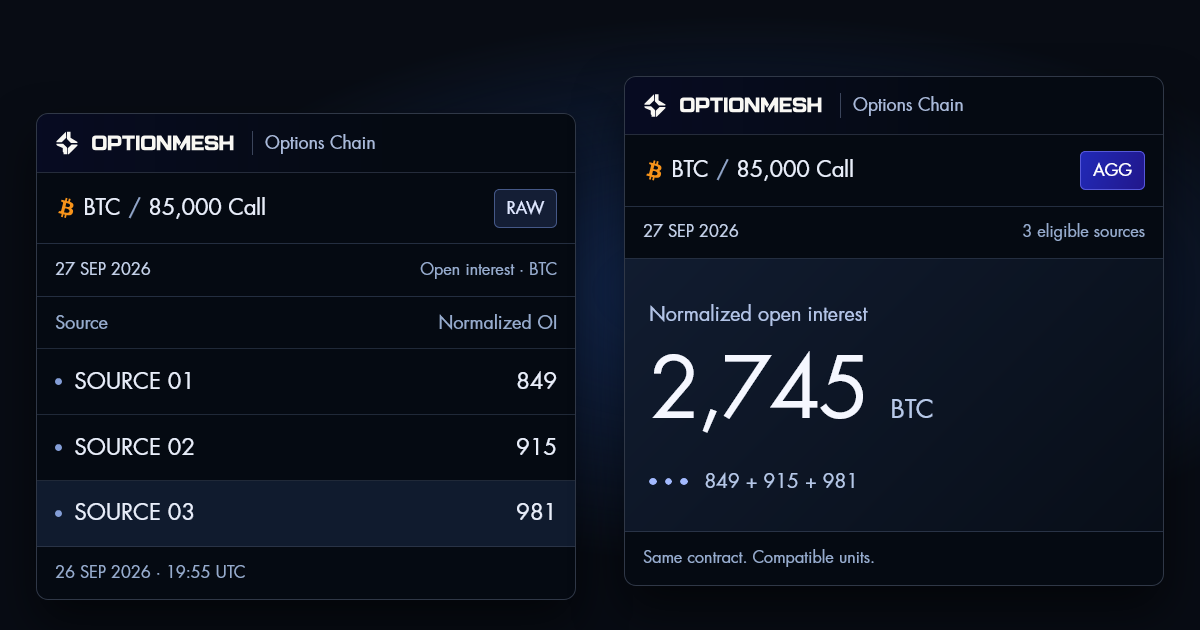
The example describes a BTC call with an 85,000 USD strike, expiring on 27 September 2026. Its illustrative snapshot time is 26 September 2026 at 19:55:00 UTC. The normalized open-interest contributions are 849 BTC, 915 BTC and 981 BTC.
| Source | Normalized OI |
|---|---|
| SOURCE 01 | 849 BTC |
| SOURCE 02 | 915 BTC |
| SOURCE 03 | 981 BTC |
| AGG · three sources | 2,745 BTC |
The sum is 849 + 915 + 981 = 2,745 BTC. RAW lets you inspect each contribution. AGG lets you read their total under the assumptions above. This is normalized open-interest quantity, not USD notional, a trade count or a prediction.
A separate IV illustration keeps SOURCE 01’s value of 45.15% in the AGG display. It is not the average of the three sources. Unlike the summed open-interest quantity, this IV is a selected source observation. This example shows why each field needs an explicit rule; it does not establish a production-wide IV methodology.
How should missing or older data be read?
An unavailable contribution is not zero. If one source is missing, a remaining total describes the available eligible observations, with partial coverage. It cannot establish that the missing source has no open interest.
Freshness and duplicates are separate checks. A source may send a newer snapshot of the same contract; that update should not automatically become another independent contribution. A retained observation can also be too old for a particular comparison without being an erroneous record.
Read observation time separately from receipt or processing time. A recently received record can still describe an older observation. Likewise, a reconnect indicator does not establish that a fresh observation has arrived.
A total can change because the eligible source set changes, even when no new trade occurred. Check coverage and exclusions before interpreting a difference between two totals.
What should you check before drawing a conclusion?
Use RAW to inspect the evidence and AGG to answer the consolidated question. Move between them while keeping the same contract, measure and source scope in view.
- Can you identify the contract, expiry time and settlement specifications?
- Are all contributions in a compatible, documented unit?
- Can you name the calculation or selection rule for this particular field?
- Can you explain which observations were included, excluded or unavailable?
- Does the result preserve source provenance and observation time?
A useful aggregate makes a comparison easier to read without making its assumptions disappear. That is the distinction to keep in mind when moving from a source observation to a shared view.
References & further reading
- OptionMesh — Data & Coverage
- Deribit — Book summary field definitions
- Contract normalization — companion guide
Examples are educational. An illustrative calculation does not establish production coverage or a trading recommendation.