

In this article
What makes a market observation fresh?
Freshness describes the age of an observation against a stated rule for a particular measure and view. A displayed value needs a source timestamp and a reference clock before that age can be assessed.
The time a system receives or processes a record answers a different question. A record received just now can describe an older observation. Likewise, a connected indicator or moving row tells you about the interface, not the age of the value behind it.
For crypto options, examine freshness at the level you are comparing. A recent quote does not automatically establish the timestamp of open interest, and a live connection does not make every retained field current.
Keep source time and receipt time distinct
Read the documented meaning of a timestamp. It may identify a trade, a book update or the creation of a response. Preserve that meaning and its time zone when converting it for display.
Deribit exposes a timestamp on an order-book response. CoinDesk’s options trade documentation distinguishes reported and received times, but also allows its trade timestamp to fall back to receipt time when an exchange supplies none. Check that field rule before treating a timestamp as an independent market observation.
If no usable observation time is available, its age is unknown. A receipt timestamp can help investigate transport or processing, but substituting it as market-observation time would require a clearly stated convention.
Deribit: order-book fields and timestamps
CoinDesk: reported and received timestamps on options trades
Worked example: four seconds versus 240 seconds
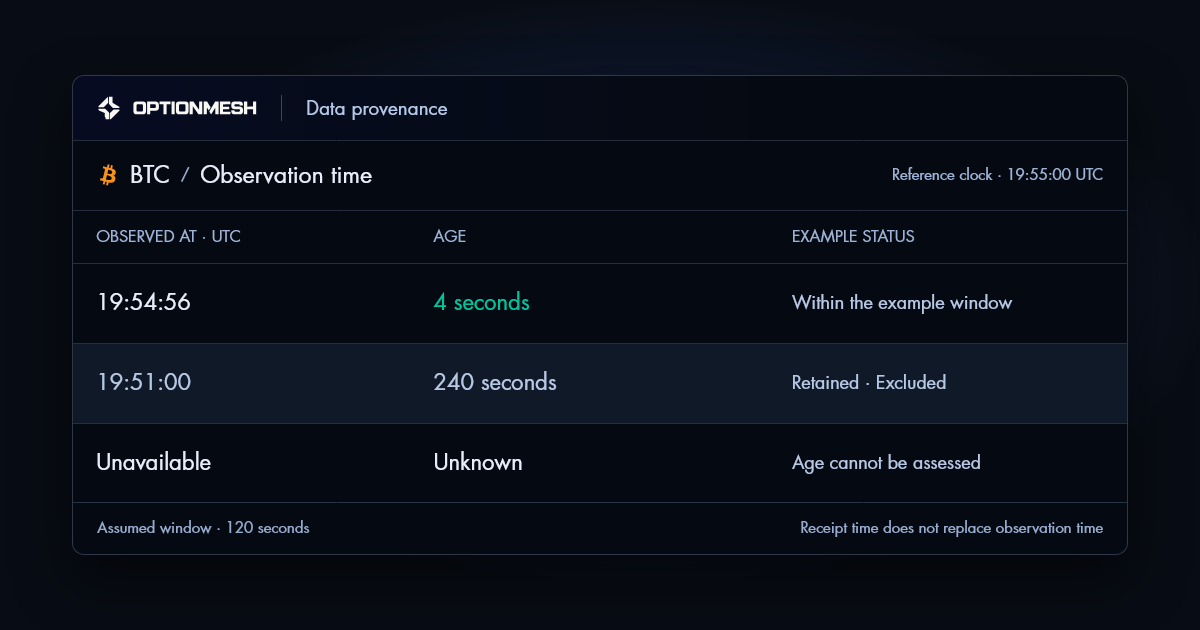
Use a synthetic reference clock of 19:55:00 UTC and an assumed 120-second eligibility window. An observation at 19:54:56 is four seconds old. An observation at 19:51:00 is 240 seconds old and lies outside that example window.
| Observed at | Age | Example status |
|---|---|---|
| 19:54:56 UTC | 4 seconds | Within window |
| 19:51:00 UTC | 240 seconds | Outside window |
| Unavailable | Unknown | Cannot assess |
The older value can remain visible as a retained observation while being excluded from this particular calculation. Retaining it and accepting it as current are separate decisions.
The 120-second threshold is chosen only for this exercise. It does not document a production threshold, an exchange update frequency or a service-level commitment. The appropriate rule depends on the source, measure and purpose of the view.
Distinguish missing values, exclusions and replacements
A missing value cannot be read as zero contracts, zero activity or zero exposure. An excluded record may still contain a valid historical observation that is too old or incompatible for the selected comparison.
A later snapshot for the same source and contract can replace a retained snapshot. Adding both as independent contributions would change the quantity being measured. Freshness checks and duplicate handling should therefore remain distinguishable in the explanation of an aggregate.
Compare which sources and records contribute at each observation time. A consolidated total can change because coverage changed, even when the values from the remaining sources did not.
What to verify after a reconnect
After a connection recovers, look for a newly timestamped observation and the source’s documented recovery behaviour. A successful connection by itself does not prove that a fresh snapshot or complete sequence has arrived.
If a source uses snapshots and incremental updates, its own ordering and resynchronization rules determine when a reconstructed state can be trusted. Do not infer completeness from animation or from receiving one message after a gap.
At the interface level, the useful distinction is between a newly observed value, a retained older value and an unavailable value. Keep the last qualified observation’s time visible until there is evidence to replace it.
A freshness check before using a comparison
- Identify the source and the documented meaning of its timestamp.
- Check age against the rule for the selected measure, not a universal “live” badge.
- Distinguish unavailable values from retained or excluded observations.
- Verify that the contributing source set is comparable between two totals.
- After recovery, look for qualified new observations before treating the view as current.
Use the OptionMesh Data & Coverage page to inspect the definitions and documented limits available for each view. The examples here explain how to ask these questions; they do not certify a production feed or threshold.
References & further reading
- Deribit: order-book fields and timestamps
- CoinDesk: options trade timestamps and sequence fields
- OptionMesh: data, measures and their limits
Examples are educational. An illustrative calculation does not establish production coverage or a trading recommendation.